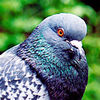
Man, in his wisdom, has thought of many ways to cull pigeons. When you look on the internet you find just how abused these birds are. Pest control companies have websites listing so many pigeon diseases that you wonder how any pigeons manage to survive. Then they helpfully tell you of the various poisons they can administer to the pigeons. They don't tend to do it publicly as it upsets people to see the poisoned birds dying, as of course it would. We prefer things to be dealt with for us without having to see any mess.

Who's the real bird-brain?

If you need any proof of the great passions aroused by the subject of pigeons, visit the messageboard for BBC Nottingham's "Speak Out". This messageboard was my first insight into the violent hatred some of our population feel about pigeons. Amongst the few who have attempted rational debate are some postings from the kind of people who are basically bullies, and seem incapable of thinking it through properly. It must be great to walk around having such simplistic and superior attitudes.

Pigeons live in towns in the first place in such great numbers because we are too messy and useless to clear up after ourselves properly, and we need help. Pigeons see all that excess food lying about and of course they eat it. Pigeons, even the feral ones, are doing us a favour, by tidying up all the crap we leave behind. Maybe instead of moaning about pigeons we should be encouraging people not to treat town centre pavements like one big refuse bin, and to use their allegedly superior brains to help them find one of those receptacles that says "Litter" on the front.

Human kindness, and pigeon prowess

Then people deliberately feed them. It seems that there are two reasons people feed pigeons in town centres: first, when you're surrounded by buildings and shopfronts and queues of traffic it's always rather nice to see a bird, particularly a friendly bird like the pigeon. Second, if you have any heart at all, you can't help but be touched by these often scraggy-looking birds eating manky trodden-in sandwiches off a dirty pavement, near a line of stinking car exhausts.

In the past we have used them and their flying abilities and their intelligence. All the animals we think are clever we use when it suits us. Later, in our urge to control everything to make our own lives as easy as possible, we want rid of the creatures that we find inconvenient.

Pigeons and disease

The other oft-quoted thing about pigeons is that "they carry disease". (Like we don't?) Town pigeons seem more susceptible to disease because they live in cramped urban conditions, and feed on the remains of the fast food we drop in the street. Remains of burgers, pizzas and chips is not their natural or preferred diet.

I had to confront the problem of pigeon diseases after a sickly pigeon visited my garden. I wasn't fearful of catching one of the much-talked-about pigeon diseases - simple commonsense and basic hygiene seemed adequate. This poor creature is now at the big pigeon loft in the sky, after being put down at the local vets. At the vets this bird was treated with respect, just as any other creature would be. Quite right too.

When you take on a sickly creature, it doesn't matter whether it's an exotic species or a plain town pigeon - they all look at you the same and you can't help but wonder what's going on behind those wary eyes. I'd suggest that the best cure for an irrational dislike of any "pest" bird is to end up having to deal with an injured, sick or frightened one.

You have to be a heartless person to not be at all affected by the dignity and acceptance of a sick or dying wild creature. In the case of pigeons, their most admirable quality is trust of humans - rather good of them, considering the way some of us treat them.

Further reading - pigeon links

Hooky the pigeon

Hooky the pigeon says "I'm descended from rock doves, you know."